
TL;DR — 4 Things to Know Right Now
- 6 warning signs your MacBook battery is failing: performance throttling, fast drain, overheating, macOS warnings, random shutdowns, and high cycle count
- Check now: Go to System Settings > Battery > Battery Health — if it says “Service Recommended,” replacement is overdue
- Malaysia note: Tropical heat and humidity accelerate battery degradation faster than Apple’s global 1,000-cycle guideline
- Act early: A RM350–400 battery replacement now prevents RM1,500+ logic board damage later
This guide is for MacBook Air and MacBook Pro owners who are noticing battery problems. It covers the 6 warning signs that mean you need to replace Macbook battery — not software fixes, not RAM upgrades, not a new MacBook. It does not cover iPad, iPhone, or batteries already physically swollen to a critical state (call us directly if your trackpad is noticeably lifting).
Your MacBook battery isn’t designed to last forever — and in Malaysia’s heat and humidity, it wears out faster than Apple’s global numbers suggest. Every charge cycle degrades it slightly. After enough cycles, a dying battery doesn’t just mean shorter battery life. The short answer: if your cycle count has crossed 1,000, your Maximum Capacity has dropped below 80%, or macOS is showing a battery warning — it’s time for a professional replacement. Keep reading for the full picture, or jump straight to our MacBook Battery Health Check Tool.
A failing battery can overheat your MacBook, corrupt your files, and in worst cases, swell up and physically damage your logic board — turning a RM350-RM900 battery swap into a RM1,500 to RM4,000 repair.
Based on the hundreds of MacBook battery replacements we complete each year at our KissMyMac Taman Desa and KissMyMac Damansara workshops, we’ve learned to spot the early warning signs that most MacBook owners miss until the damage is already done.
RECOMMENDED READ : Know When To Replace Macbook Battery
Table of Contents
Table of Contents
Common Symptoms Your Macbook Need Battery Replacement

1. Your MacBook Feels Painfully Slow — And Nothing Fixes It
You’ve tried restarting. You’ve closed all your apps. You might have even reinstalled macOS. But your MacBook still crawls.
Here’s what most people don’t realise: macOS deliberately throttles your processor when the battery can’t deliver enough power. Apple calls this “performance management” — your Mac slows itself down to prevent sudden shutdowns.
This means the sluggishness isn’t a software problem. It’s your battery silently failing behind the scenes.
The telltale sign: Your MacBook runs fine when plugged in but turns sluggish the moment you go on battery power. If this sounds familiar, your battery is the bottleneck — not your RAM, not your storage, not your macOS version.
We see this misdiagnosis regularly at our workshop — customers who’ve already spent money on RAM upgrades or clean installs, feeling frustrated that nothing helped. The moment we run a battery diagnostic, the real culprit shows up immediately. The worn-out battery was throttling the processor the whole time.
Don’t waste time and money on fixes that won’t work. Book a free battery diagnostic at KissMyMac — we’ll confirm the issue in minutes and tell you honestly if it’s the battery.
2. Your Battery Barely Lasts 2 Hours (When It Used To Last All Day)
Remember when your MacBook could get through a full workday on a single charge? If you’re now scrambling for a power outlet before lunch, your battery’s capacity has degraded significantly.
Here’s how it works: every MacBook battery is rated for a certain number of charge cycles — typically 1,000 cycles before it drops below 80% of its original capacity. After that, the decline accelerates fast.
What this looks like in real life:
- Your MacBook shows 100% but dies within 1–2 hours
- The battery percentage jumps erratically — 60% one minute, 25% the next
- You can’t leave your desk without a charger anymore
MacBook owners who purchased their machines between 2019 and 2022 are hitting this wall in large numbers right now. A fresh battery restores your MacBook to full-day battery life, often for a fraction of the cost of buying new.
In Malaysia’s heat and humidity, we typically see batteries showing significant degradation 6–12 months sooner than the same model would in a cooler, drier climate. If your MacBook lives near a window or in a warm home office, factor that in — your battery is ageing faster than Apple’s global numbers suggest. For a deeper look at tracking battery health over time, read our guide on how to check your MacBook battery health.
Tired of being chained to your charger? Get your MacBook battery replaced at KissMyMac — most replacements done in 30 minutes, and you’ll get your all-day battery life back.
3. Your MacBook Overheats During Normal Tasks
If your MacBook gets uncomfortably hot — that sweaty-palm-on-aluminium heat — just browsing the web, checking email, or watching YouTube, something is wrong.
A healthy battery generates minimal heat during normal use. But a degraded battery has to work harder to deliver the same power, generating excess heat. Combine that with macOS pushing the fans to compensate, and you’ve got a MacBook that sounds like a jet engine just to run Safari.
We’ve opened enough MacBooks at our workshop to know the feel of a failing battery running hot — the aluminium chassis above the battery area is noticeably warmer to the touch even at idle, and the fans are spinning before you’ve opened a single demanding app. In our experience, battery-related overheating makes up a significant portion of the overheating cases we diagnose. The rest of the causes are explained in our guide on what makes MacBooks overheat.
Why this is dangerous: Sustained overheating doesn’t just feel uncomfortable — it accelerates wear on your SSD, display, and logic board. Every day you ignore it, you’re shortening your MacBook’s overall lifespan.
On Apple Silicon MacBooks (M1, M2, M3, M4): These chips are incredibly power-efficient, so overheating during light tasks is an even stronger indicator of battery failure. Apple Silicon is designed to run cool under normal loads — if your M-series MacBook runs hot browsing the web, the battery is almost certainly the culprit, not the chip.
[IMAGE: Close-up photo of MacBook base plate showing heat discolouration above battery compartment area | Alt: “MacBook base plate showing thermal stress marks above battery compartment, photographed at KissMyMac repair workshop” | Caption: “A degraded battery radiates heat through the chassis floor. This is what sustained battery overheating looks like after years of tropical Malaysian heat.”]
An overheating MacBook is damaging itself every time you use it. Book a diagnostic at KissMyMac before a RM350–900 battery issue becomes a RM1,500+ logic board problem.
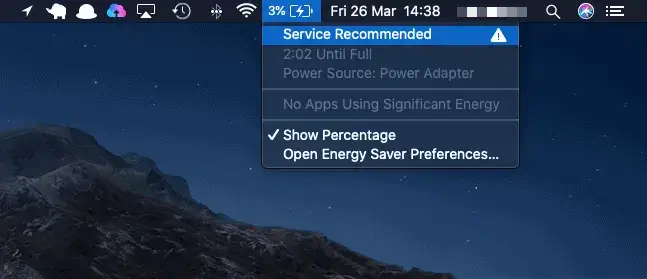
4. macOS Is Warning You — “Service Recommended” or “Replace Now” – Meaning You Need To Replace Macbook Battery
This is the one you absolutely cannot ignore.
Click the battery icon in your menu bar, or go to System Settings > Battery > Battery Health. If you see any of these messages, your battery has officially failed Apple’s own health threshold:
- “Service Recommended” — Battery health has dropped significantly
- “Replace Soon” — Battery is degraded and affecting performance
- “Replace Now” — Battery has critically low capacity
Apple doesn’t display these warnings lightly. By the time you see “Service Recommended,” your battery is already well below 80% of its original capacity.
On macOS Ventura and later, you can see your exact Maximum Capacity percentage and Cycle Count in Battery Health settings. If your Maximum Capacity is below 80%, replacement is overdue — whether or not a warning appears.

If your Mac is showing a battery warning, don’t wait. A failing battery can swell and damage internal components. Book your MacBook Battery replacement at KissMyMac today — walk in, walk out in 30 minutes.
5. Your MacBook Shuts Down Without Warning — Even With Battery Left (99% You Need To Replace Macbook Battery)
You’re in the middle of an important email. Your battery shows 40%. Then — black screen. No warning. No “low battery” notification. Just dead.
This is one of the most dangerous symptoms of a failing battery. Random shutdowns mean your battery can no longer deliver stable voltage to your system. When voltage drops unexpectedly, your MacBook has no choice but to cut power instantly.
What’s at risk:
- Unsaved work — gone in an instant
- File corruption — sudden shutdowns can corrupt your macOS system files and documents
- SSD damage — repeated forced shutdowns degrade your storage drive over time
In our experience at the repair bench, customers who come in after repeated random shutdowns often show early signs of SSD wear that wouldn’t have been there if the battery had been replaced at the first warning. It’s an expensive lesson in why “I’ll deal with it later” is rarely a safe option with battery symptoms. Random shutdowns are just one of the most common MacBook hardware failures we see — and almost always preventable.
If your MacBook shuts down randomly — especially when it still shows battery remaining — this is not a software glitch. This is a hardware failure that gets worse, not better.
Random shutdowns put your data at risk every single time. Don’t gamble with your files — book a battery replacement at KissMyMac before you lose something important.
6. Macbok Battery Having High Cycle Count
Every time you use a full charge worth of battery — whether that’s 100% in one go or 50% twice — that’s one cycle. macOS tracks this number automatically.
To check your cycle count:
Go to Apple Menu > About This Mac > System Report > Power — your current cycle count is listed there.
Here’s the KissMyMac Battery Health Matrix — based on Apple’s official cycle count specifications and what we actually see in daily repairs:
| Cycle Count | Battery Status | What to Do |
|---|---|---|
| Under 500 | Healthy — performing well | Monitor annually |
| 500–800 | Ageing — monitor closely | Check Maximum Capacity quarterly |
| 800–1,000 | Worn — noticeable degradation likely | Book a diagnostic |
| Over 1,000 | End of life — replacement recommended | Replace before symptoms worsen |
Apple rates most modern MacBook batteries for 1,000 cycles before they drop below 80% capacity. But in Malaysia — where ambient temperatures regularly hit 32–35°C and humidity stays above 70% year-round — we see accelerated degradation that pushes MacBooks past their useful battery life noticeably earlier than Apple’s global benchmarks. Heat is a lithium-ion battery’s enemy, and Malaysia has plenty of it.
High cycle count? Your battery is living on borrowed time. Get it replaced at KissMyMac before it starts causing bigger problems.
Why You Shouldn’t Wait to Replace MacBook Battery (Especially A Dying Macbook Battery)
A battery replacement is one of the most affordable MacBook repairs. But the damage a failing battery causes? That’s where it gets expensive.
What happens when you ignore a dying battery:
- Swollen battery — pushes against the trackpad and display, warping your MacBook’s chassis
- Logic board damage — a swollen or leaking battery can short-circuit components, leading to RM1,500+ repairs
- Data loss — random shutdowns corrupt files and can make your drive unrecoverable
- Reduced resale value — a MacBook with a dead battery is worth significantly less on the secondhand market
What happens when you replace it early:
- Full-day battery life restored
- Faster performance (no more CPU throttling)
- Cooler, quieter operation
- Your MacBook feels like new — for a fraction of the cost
Stop Buying New — Here’s Why the Math Doesn’t Add Up
Every week, customers come into our workshop and say: “Maybe I should just buy a new MacBook instead.”
We respect that instinct. But in almost every battery case, the math doesn’t support it — and we’ll show you why.
The conventional wisdom that “old MacBooks aren’t worth repairing” applies to logic board failures, cracked displays, or severe water damage — not battery wear. A battery is a single replaceable component. The rest of your MacBook — logic board, display, keyboard, SSD, speakers — is likely in perfect working condition.
The actual numbers:
| Option | Cost | What You Get |
|---|---|---|
| Battery replacement at KissMyMac | RM350–900 | MacBook running like new, all data intact |
| New MacBook Air M4 (entry) | From RM5,499 | Faster chip, but everything else equivalent |
| Used/refurbished MacBook | RM2,500–4,000 | Unknown battery health, unknown history |
A RM350 battery replacement versus a RM5,499 new MacBook is a 15x price difference for a problem that is a single component failure.
Based on what we see from the hundreds of battery replacements we complete each year, the vast majority of customers report their MacBook feels like a new machine after a fresh battery — especially when the performance throttling had been masking what the Mac was actually capable of. Nine times out of ten, the rest of the machine is fine.
The real question isn’t “repair or replace?” It’s: does the rest of your MacBook still work? If yes, repair wins every time. If you’re also dealing with a failing display, liquid damage, or a cracked chassis — that’s a different conversation, and we’ll tell you honestly which way to go.
Apple Silicon Owners: Your Battery Matters Even More
If you own an M1, M2, M3, M4 or M5 MacBook, you’ve got one of the most capable laptops ever made. But all that performance depends on a healthy battery.
Apple Silicon chips are designed to dynamically adjust power delivery based on demand and battery state. When the battery degrades, these chips can’t operate at their designed efficiency — and you’ll feel it in everything from app launch times to export speeds.
Use case guide for Malaysian MacBook owners:
- M1/M2 MacBook Air (used in air-conditioned office): If you’re under 500 cycles and already seeing less than 8 hours, check your Maximum Capacity first — the Air’s fanless design means heat management depends entirely on battery health
- M1/M2/M3 MacBook Pro (heavy workload use): Over 700 cycles on a Pro? Worth a diagnostic — Pro chassis runs warmer under load, and Malaysia’s ambient heat compounds this
- All M-series: If macOS shows “Service Recommended,” don’t wait regardless of cycle count — the warning has already been delayed; the real degradation is worse than the number suggests
The good news: because Apple Silicon is so power-efficient, a fresh battery on an M-series MacBook delivers exceptional battery life — often 15–20 hours under normal use. If you’re getting less than half that consistently, a battery replacement brings it right back.
What We See At The Repair Bench
After completing hundreds of MacBook battery replacements annually across our Kuala Lumpur, Damansara and Seremban 2 workshops — here’s what we actually encounter.
Our diagnostic process: Every MacBook that comes in for a battery assessment goes through our Diagnostics routine first, followed by a battery cycle test and a physical inspection for internal swelling. This tells us the exact Maximum Capacity, current cycle count, and whether swelling pressure has begun against the chassis. The whole assessment takes about 10 minutes, and it’s free.
What we consistently find in Malaysia:
- Batteries in MacBooks that live in warm environments — cars, non-air-conditioned rooms, near windows with direct sunlight — show measurable capacity loss 6–18 months earlier than the same model in a temperate climate
- Intel-era MacBook Pros from 2015–2020 are currently our highest-volume battery replacement model — the combination of age, Malaysian heat, and demanding workloads has pushed many well past 1,000 cycles
- Swollen batteries make up a meaningful portion of the batteries we replace. In every one of those cases, the owner reported ignoring an earlier “slow Mac” or “short battery life” symptom for months before acting
The pattern is consistent: customers who replace early spend RM250–400. Customers who wait spend RM1,500–2,500 on logic board repairs, data recovery, or both.
A note on methodology: Our assessments use Apple-licensed diagnostic software and a standardised battery cycle protocol. We record Maximum Capacity, Cycle Count, and charge health for every battery we replace — which is how we’ve built up the pattern recognition that informs this guide.
Should You Replace Your Battery? Quick Decision Checklist
We have created this battery checker tool to help you see if it’s time to book a Macbook battery replacement. The more boxes you tick, the more urgent your situation.
Book a Free Battery Diagnostic at KissMyMac →
Frequently Asked Questions (FAQ)
How long does a MacBook battery replacement take?
At KissMyMac, most MacBook battery replacements are completed in 30 minutes to 45 minutes. Walk in during your lunch break and walk out with a MacBook that lasts all day again.
How much does it cost to replace a MacBook battery in Malaysia?
Professional MacBook battery replacement at KissMyMac starts from RM350, depending on your MacBook model. That’s a fraction of the cost of the logic board damage a failing battery can cause — and far less than the cost of a new MacBook.
Can a bad battery damage my MacBook?
Yes — a swollen battery can warp your trackpad, crack your display from the inside, and short-circuit your logic board. What starts as a simple battery swap can turn into a RM1,500+ repair if left too long.
How do I know if my MacBook battery needs replacing?
Check System Settings > Battery > Battery Health on your Mac. If you see ‘Service Recommended,’ if your Maximum Capacity is below 80%, or if your Cycle Count exceeds 1,000, it’s time for a professional replacement. One more thing, If you see your battery’s maximum capacity is exceptionally low, you should consider to replace your Macbook battery as well. Generally, For A Brand New Macbook Battery, The battery Capacity (mAh) should be around 4000-5000
Does replacing the battery make my MacBook faster?
In many cases, yes. macOS throttles CPU performance when the battery can’t deliver stable power. A new battery removes this throttling, and many customers are surprised by how much snappier their MacBook feels after a replacement.
Is it worth replacing the battery on an older MacBook?
For most MacBooks from 2017 onwards, absolutely. A RM350-950 battery replacement can add 3-5 more productive years to your machine. Compare that to RM5,499+ for a new MacBook Air M5 — the value is clear.
How does Malaysia’s climate affect MacBook battery life?
Malaysia’s tropical climate — consistently 30-35°C and high humidity year-round — accelerates battery degradation compared to Apple’s global benchmarks. MacBooks in Malaysian tropical environments can show significant capacity loss 6-18 months earlier than the same model in a cooler, drier climate.
Written By
I am the Co-Founder of KissMyMac® Malaysia, an Apple Certified Technician at KissMyMac with More than 8 Years Of Experience In The Apple Repair Industry. We specialize in Macbook Repairs, iMac Repair, iPhone Repair, iPad Repair in KissMyMac. We have dealt with more than 30,000+ Apple repairs throughout our years working in this industry, from a small repair shop to where we are now with 3 branches across Malaysia – KissMyMac Kuala Lumpur, KissMyMac Petaling Jaya, and KissMyMac Seremban